Programs
B.Tech in Civil Engineering
About Program
Imagine shaping the world around you—designing skyscrapers, constructing resilient bridges, and building sustainable urban environments. Civil Engineering is more than just blueprints and concrete—it’s the foundation of modern civilization.
At GRD Uttarakhand University, our program of B.Tech in Civil Engineering in Dehradun empowers students with technical expertise and real-world exposure. From roads, airports, and dams to smart cities and climate-resilient infrastructure, this program equips students to lead in every facet of civil infrastructure.
New Age Engineering with Dual Specialization (Industry 5.0): a four-year, 180-credit B.Tech that joins digital intelligence (programming, AI, data and security) with physical systems (VLSI, embedded systems, machines and drives). Students go deep in two specializations of their choice, which are co-designed, co-delivered and co-certified with industry.
-
Duration
-
4 Years
(8 Semesters, 180 Credits – Regular Entry)
-
3Years
(Lateral Entry)
 B.Tech Civil Engineering

Eligibility Criteria
For 4-Year B.Tech Program
Minimum
50% marks
in Class X & XII
Minimum
50% marks
in Physics, Chemistry, and Mathematics
For 3-Year Lateral Entry
3-Year Diploma in Civil or related Engineering
60% marks
in Science & Math
From a recognized State Board of Technical Education


Program Educational Objectives (PEOs)
The program of B.Tech in Civil Engineering in Uttarakhand at GRD Uttarakhand University aims to:
Solve real-world problems using innovative, sustainable approaches
Build strong foundations in design, analysis, and computing skills
Develop leadership and teamwork in large-scale engineering environments
Ensure graduates adapt to global infrastructure and technological trends
Scope and Teaching Method
Scope
With a surge in smart cities, green buildings, and infrastructure development, Civil Engineering continues to be one of the most relevant and respected professions globally.
- Structural, Geotechnical & Environmental Engineering
- Water Resources Management & Transportation Systems
- Government Infrastructure Projects (PWD, NHAI, Urban Planning)
- Global opportunities in the Middle East, Europe, and Southeast Asia
New Age Engineering with Dual Specialization: the core subjects are the same in every branch, and every student chooses any two specializations from ten industry co-designed baskets. Specialization I runs from Semester III to VI, and Specialization II, from a different basket, runs from Semester V to VIII.
Cyber-Physical & Mobility
- Robotics & Autonomous Systems – Robotics Engineer, ROS Developer, Automation Engineer
- Smart Manufacturing & Industrial Automation – Manufacturing Systems Engineer, Digital Twin Engineer, Reliability Analyst
- Embedded Systems, IoT & Edge Intelligence – Embedded Engineer, IoT Solutions Engineer, Edge AI Developer
- Autonomous Aerial Systems – UAV/Drone Engineer, Computer Vision Engineer, Flight Autonomy Developer
- Aerospace & Avionics – Avionics Engineer, Flight Data Analyst, Space Systems Engineer
- Electric Vehicles – EV Systems Engineer, Automotive Software Engineer, ADAS Engineer
Computing & Data
- AI & ML – ML Engineer, NLP Engineer, AI Solutions Engineer
- Data Science – Data Engineer, Data Analyst, BI Developer
- Cyber Security & Forensics – Security Analyst, Penetration Tester, Forensics Analyst
- Modern Software Engineering – Software Engineer, Cloud/DevOps Engineer, Backend Developer
Flexible exits: Certificate after Year 1 (42 credits), Diploma after Year 2 (99 credits), Advanced Diploma after Year 3 (152 credits), and the B.Tech degree after Year 4 (180 credits).
Learning by doing: 22 credits of internships and projects, covering the Social Internship, Civil Internship, two Minor Projects, a Summer Internship and two Major Projects.
Teaching Methodology
- Project-Based Learning – Real-world civil projects embedded in coursework
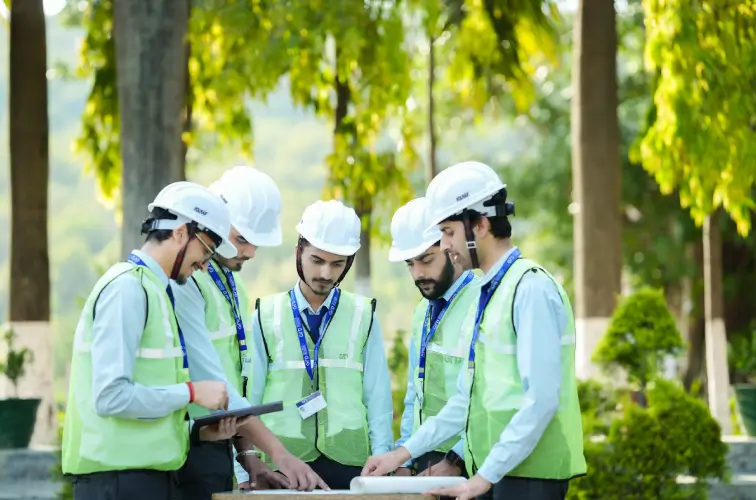
- Industry Exposure – Internships, site visits, guest lectures
- Hands-on Lab Work – Soil, concrete, surveying, and environmental labs
- Software Training – STAAD Pro, AutoCAD Civil 3D, GIS tools, BIM
- Collaborative & Ethical Practice – Emphasis on leadership and sustainability


Career Options
Graduates can pursue careers in:
- Structural Engineering
- Transportation & Traffic Engineering
- Geotechnical & Soil Engineering
- Environmental Engineering
- Water Resource Management
- Public Sector (PWD, NHAI, DRDO, Irrigation Dept.)
- Infrastructure & Real Estate Projects
- Project Management & Consultancy
- International roles in infrastructure & construction

Frequently Asked Questions (FAQ)
Students participate in internships at construction firms, consultancy agencies, and government bodies like PWD, NHAI, etc.
We offer fully-equipped labs in Structural, Geotechnical, Environmental, Surveying, and Concrete Technology.
Project-based learning, industry exposure, and hands-on training with real-time site visits and latest civil engineering tools.